Orhan ALİMOĞLU
Tüm Yazıları“My work is with children. I am a pediatrician.”
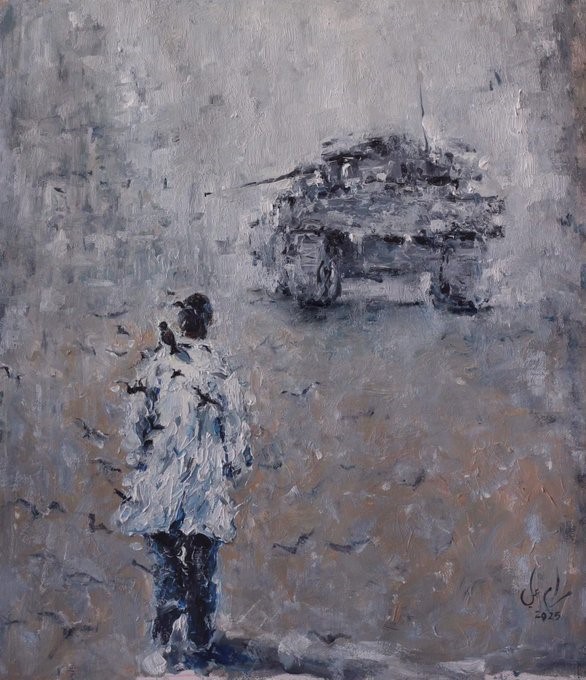
On 27 December 2024, Israeli occupation forces surrounded Kamal Adwan Hospital in Gaza and ordered its evacuation. Moments later, from the ruins of the hospital—encircled by dozens of tanks—a doctor emerged wearing his white coat and began walking alone toward the tanks. Captured in one of the most iconic images of modern warfare, this moment stands as an emblem of honor for the medical profession and for the very notion of being a doctor, and as a moment of shame for humanity and for history. Palestinian painter Maram Ali immortalized this honor and this shame with her brush, engraving them into the conscience of humankind.
In Gaza, not only women and children were killed; all the humanity values have ever claimed to create were slaughtered as well. Alongside the ear-splitting roar of warplanes, missiles, tanks, and countless other instruments of destruction, justice, morality, and innocence were annihilated by the world’s deafening, hope-shattering silence. Yet, life itself and the profound faith in life, broke through the mute barriers of war machines and petrified hearts, reaching every soul still capable of remaining human.
From beneath the rubble and ruins of Gaza, a persistent whisper reaches the ears: “Even under the debris, hearts continue to beat.” It is not the dead who whisper, but a conscience that resists death, resists humiliation, and cries out—out of sheer defiance—for life and hope in a Gaza reduced entirely to wreckage. For more than two years, this conscience has shaken the world awake, stirring country after country, city after city, street after street into a vigil of protest.
Throughout these ominous times, when darkness has held the entire globe captive, the world has also borne witness to countless acts of heroism—bodies and souls set ablaze to keep hope alive for human existence, innocence, and morality. With his dignified and courageous walk toward the tanks, Dr. Hussam Idris Abu Safiya came to embody the stubborn rhythm of that healing conscience, standing watch with quiet resolve for a life that was being systematically erased.
Dr. Hussam Abu Safiya is a pediatrician, a husband, and a father. As the director of Kamal Adwan Hospital, he transformed medicine and science into a relentless act of survival, bearing witness to his era with his very life, keeping an unspoken ledger for the Day of Reckoning. “I am speaking to you from the heart of the siege,”[1] he once said. This was no metaphor; it was the starkest form of reality. His hospital was the heart, and the siege was the tightening cage around it.
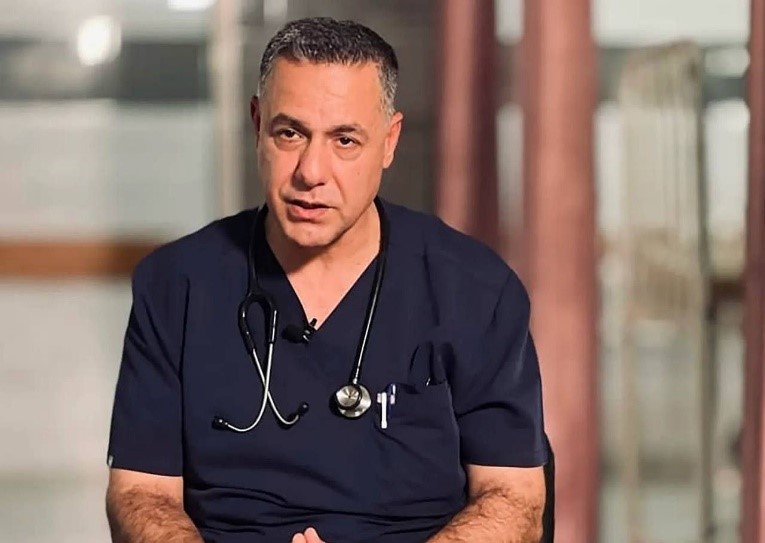
He was born on 21 November 1973 in the Jabalia Refugee Camp, a child of a displaced family. His family had been expelled in 1948 from Hamama[2], located 24 kilometers north of Gaza, following terrorist attacks by colonial militias. Like every Palestinian, Hussam grew up knowing that survival was never guaranteed. To live in Palestine, fragmented and occupied piece by piece by Israeli settlements, is to live perpetually on the edge of death. In the streets of Gaza, where death roamed freely, Hussam grew up internalizing the value of life more deeply with each passing day. He was a diligent student, a child with a strong sense of responsibility.
After completing his secondary education, he earned admission to medical school and traveled to Kazakhstan for his studies. There, after years of rigorous and successful training, he completed his specializations in pediatrics and neonatology. The 1990s he spent in Kazakhstan brought him not only professional expertise but also a life partner, Albina, who would become his unshakable support through years of exile and wars marked by devastating losses. Following the birth of their first son, Elias, Albina and Abu Safiya returned to Gaza in 1998 and settled in the Jabalia refugee camp. In the years that followed, Albina gave birth to three more sons and two daughters.[3]
For years, Dr. Hussam served at Kamal Adwan Hospital in northern Gaza. Thousands of babies were born into this hostile world in his compassionate, skilled hands. He was not only a pediatrician and neonatologist, but also a source of guidance for young mothers, families, and complicated births, a center of gravity offering solutions and moral support. Having successfully passed the examinations of the Palestinian Medical Council, Dr. Hussam often said, “My work is with children. I am a pediatrician.”[4]
After 7 October 2023, as the Israeli occupation forces’ attacks escalated into a full-scale genocide, new burdens fell upon Dr. Hussam Abu Safiya’s shoulders, beyond those of his patients. He had become the hospital’s director. As he himself stated, he did not regard this as a promotion, but as a responsibility. Gaza’s healthcare system was collapsing; water and sanitation networks had been destroyed, electricity was nonexistent, medical supplies had been cut off. Under these dystopian conditions, managing a hospital became an immense moral and professional burden. When fuel for electricity ran out, he performed resuscitations by candlelight. When incubator heaters stopped working, he tried to warm premature infants with his own breath. During moments of extreme scarcity, he was forced to make agonizing decisions that defied reason—deciding whose lives might be saved and who would be left to die. When his colleagues fell into despair, he would quietly tell them, “As long as we breathe, they will breathe too.”[5]
Amid his medical and administrative duties, Dr. Hussam struggled to make Gaza’s silenced voice heard by the world. From the darkened wards of a hospital where lights, medical devices, ventilation, and hygiene systems had all fallen silent, he called out: “Once again, we remind the world: there are laws you proudly uphold, the Geneva Conventions, that protect hospitals and healthcare workers. Please, protect hospitals and healthcare workers.” Yet the world’s major powers, UN bodies, states, and international organizations remained deaf and blind to these appeals.[6]
Dr. Hussam was truly standing a vigil for life. He was repeatedly threatened and ordered to leave the hospital. Both Israeli forces and other people offered him “safe passage” many times, but he refused every offer. His answer never changed: “This is an extremely sensitive time. This is when my patients need me most. I will serve until my last breath.” He believed that leaving would mean turning his back on patients, infants, and life itself—and that both human values and medical ethics demanded staying, not abandoning, and striving for life under all circumstances. And so he stayed. He never abandoned his patients, the babies, his ward, or his hospital.[7]
As the siege intensified, he began photographing the hospital’s interior, documenting suffering children and weeping mothers in an attempt to awaken the world’s conscience. He sent videos again and again, his voice calm yet despairing, addressing humanity itself. But the world remained silent. His wife Albina would later say in anguish: “We show the children, but the world does not want to see.”
The war drew closer with each passing day. In October 2024, during a drone attack at the hospital’s entrance, his son Ibrahim was killed. His heart in flames, Dr. Hussam personally led his son’s funeral prayer, surrounded by patients and healthcare workers.[8] As he lowered his son’s body into a temporary grave within the hospital complex, a call came from the intensive care unit: a child was in respiratory failure. He wiped away his tears, left the ceremony unfinished, and ran back to the hospital. Albina recalls that moment: “He could not distinguish between his own child and his patients. He treated every one of them as his own.”[9]
A few weeks later, he was injured by shrapnel during an inspection inside the hospital, yet once again refused evacuation. “This will not stop us,” he told journalists. “My blood is not more valuable than that of my colleagues or the people we serve.” Using crutches, he continued to walk through the wards and care for his patients.[10]
As the siege tightened further, Israeli occupation forces, seeking to punish Dr. Hussam personally, killed his 21-year-old son Ibrahim and injured him directly, yet failed to break his resistance to life. Finally, on 27 December 2024, Israeli forces surrounded Kamal Adwan Hospital and ordered everyone to evacuate. The image of him walking toward the tanks in his white coat was taken that day. On the spot, he was severely humiliated, assaulted, and immediately detained. He was later transferred to the Sde Teiman Detention Center in the Negev Desert, where he was subjected to severe torture and interrogations, and then moved to Ofer Prison, notorious for torture and sexual abuse.[11] At last, the occupation forces had managed to silence Dr. Hussam Abu Safiya.[12]
For six weeks, he was denied access to a lawyer, held in solitary confinement, and interrogated without rest. When his lawyer finally saw him, he had lost more than 40 kilograms; his ribs were broken, his heartbeat irregular. He suffered from chest pain, dizziness, and loss of vision. Yet what struck his lawyer most was his resilience. “They tried to break me,” he said, “but I still hear the voices of children. That is what keeps me alive.”[13]
He is currently detained under Israel’s “Unlawful Combatants Law,” which allows indefinite detention without charge or trial. Human rights organizations state that this law openly violates the Geneva Conventions and fundamental principles of justice.[14] This indefinite, unlawful detention—accompanied by grave human rights violations, torture, starvation, and abuse—constitutes a siege not only on Dr. Abu Safiya, but also on his family. His wife Albina describes their brief visits: “Each time he looks weaker, paler, but there is still a light in his eyes. He tells me, ‘Do not cry. Whatever I did, I did for the children of Gaza.’”
By mid-2025, his condition had deteriorated further: severe malnutrition, cardiac arrhythmia, recurrent infections. Yet he continued to tell his lawyer, “I refused to abandon the hospital and my patients. That is why the army punished me by killing my son.”[15]
When a fragile ceasefire began in Gaza, his name was expected to appear on the list of those to be released which was an outcome long awaited by the global medical community, human rights organizations, and his family. But when the list was announced, his name was absent. Instead, the court extended his detention by another six months without providing any justification.[16] For his family, this was a new devastation.
The professional lives of Gaza’s doctors, Dr. Hussam Abu Safiya foremost among them, give rise to an ironic paradox: working for healing and health becomes resistance itself. His profession was medicine, yet his very existence turned into a challenge. His professional effort was, in essence, a rebellion against allowing violence to define the value of life.
In his story, the boundaries between doctor, father, and prisoner dissolve, leaving only conscience behind. Like stones standing firm in an emptied valley, his determination remains unshaken. His voice, once echoing through the corridors of Kamal Adwan Hospital, still lives on in the words of those who remember him: “My work is with children. I am a pediatrician.”
And somewhere behind the walls of Ofer Prison, that heart continues to beat, just as the mysterious whisper heard in Gaza’s streets says: “Even beneath the rubble, hearts continue to beat.”
I would like to thank Intern Dr. Abdel-Rahman Farwanah, journalist-author Mustafa Ekici and Sudenaz Coskun for their contributions.
Prof. Dr. Orhan Alimoğlu,
Istanbul Medeniyet University
[1] https://newyorkwarcrimes.com/dr-safiya-dispatches
[2] https://www.sciencedirect.com/science/article/pii/S0305748823000853?via%3Dihub
[3] https://www.aljazeera.com/features/2025/10/29/gazas-dr-hussam-abu-safia-is-still-held-by-israel-no-sign-of-release
[8] https://www.yeniakit.com.tr/haber/oglu-sehit-olan-gazzeli-doktor-cocuklarimizi-hastane-bahcesine-gomuyoruz-1896776.html
[9] https://serbestiyet.com/dis-haber/israil-kemal-advan-hastanesine-girdi-son-ana-kadar-direnecegim-diyen-bashekimden-haber-alinamiyor-192217/
[10] https://www.aa.com.tr/tr/dunya/kemal-advan-hastanesi-muduru-ebu-safiyye-gazzede-israil-isgaline-karsi-direnisin-sembolu-oldu/3437727
[11] https://www.aa.com.tr/tr/dunya/israilli-avukat-israil-hapishanelerinde-gozlerini-bagladiklari-filistinlilere-tecavuz-ediyorlar/3748957
Güncel Yazıları
A Young Dentist: Dr. Tawfiq Jamal Al-Farra
14 Mayıs 2026
A Doctor of Courage: Fadil Naim
12 Mayıs 2026
Abdul Hamid Mahmoud Qardaya: A Physiotherapist Who Rebuilt Lives in the Midst of Dest..
27 Nisan 2026
Genç Diş Hekimi: Dr. Tawfiq Jamal Al-Farra
27 Nisan 2026
Cesaret Timsali Bir Doktor: Fadil Naim
24 Nisan 2026
Abdul Hamid Mahmoud Qardaya: Yıkımın Ortasında Hayatları Yeniden İnşa Eden Bir Fizyot..
20 Nisan 2026
In Memory of Dr. Razan Barhoum
05 Şubat 2026
Dr. Razan Barhoum'un Anısına
29 Ocak 2026
Devoted Dentist: Mahmoud Fouzi Ismail Al Akkad
26 Ocak 2026
Fedakar Diş Doktoru: Mahmoud Fouzi İsmail Al Akkad
12 Ocak 2026
The Sentinel of Life: Dr. Hussam Abu Safiya
02 Ocak 2026
Yaşam Nöbetçisi: Dr. Hussam Abu Safiya
15 Aralık 2025
A Doctor Symbolizing The Profession of Surgery : Dr. Ahmad Qandeel
14 Kasım 2025
Shattered Hopes: Junior Dr Yara Nader El-Hossari
10 Kasım 2025
Cerrahlık Mesleğinin Sembolü Bir Doktor: Dr. Ahmad Qandeel
05 Kasım 2025