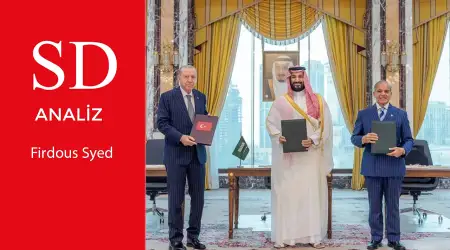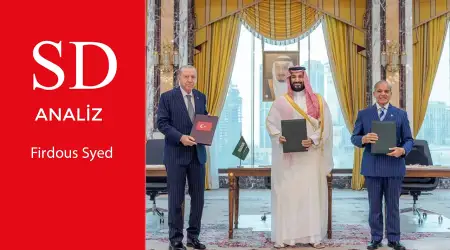
A defense pact between Türkiye, Pakistan and Saudi Arabia was signed in Mecca, the holiest city in Islam, on a Friday, after which the three leaders stood together in the Grand Mosque for Friday prayers. For three major Muslim powers to formalize such an understanding in Islam's sacred center inevitably invested the occasion with significance far beyond diplomatic ceremony.
But what of the substance? If this is a collective-defense pact, who is the common adversary? What precisely constitutes aggression, and how would the collective-defense commitment operate in practice? These and other questions inevitably arise from an agreement of such potential strategic consequence and demand clear and authoritative explanation.
Hakan Fidan, Türkiye’s foreign minister, an erudite diplomat and statesman with a keen grasp of the changing geopolitical landscape, has provided much of that explanation with remarkable clarity. He describes its collective-defense principle as technically analogous to NATO’s Article 5, while stressing that the agreement identifies no “common threat” and that Iran is not a target: “No country that does not attack us is a target of ours.” He further emphasizes that Türkiye, Pakistan and Saudi Arabia are not expansionist states. It is, therefore, a pact designed to deter aggression and ensure collective defense, without identifying or presupposing an enemy.
In an understated but significant formulation, Fidan then sets out the broader philosophy underlying the initiative, security, in Türkiye’s conception, must increasingly rest upon regional ownership. External hegemons, he argues, have not resolved the region’s problems; its own states must instead develop institutional mechanisms capable of ensuring collective security, economic stability, development and prosperity. It is in this broader context that Fidan characterizes the Mecca Agreement as perhaps the most important step towards bringing lasting stability to a region that, as he explicitly observes, has been associated with instability for the past century, since the withdrawal of the Ottoman Empire.
The logic of regional ownership also suggests that the arrangement is intended to extend beyond its three founding members. Fidan describes Türkiye, Pakistan and Saudi Arabia as the “core countries” and says President Erdoğan’s vision is to expand the arrangement beyond them. Egypt was already part of the four-country consultations that preceded the agreement, and Fidan expects it to join in the next phase, describing it as a natural partner in the emerging framework. The pact will also acquire a practical military dimension through joint exercises and training intended to establish interoperability, the capacity of their armed forces to act in unison.
What makes Fidan’s explanation particularly striking is that much of the strategic thinking he has now articulated publicly had been expressed, with remarkable similarity, by a distinguished senior intellectual in conversation with this author only a few weeks earlier at a highly respected think tank in Ankara. Combining unusual analytical depth with an almost idealistic sweep of imagination, he outlined what then appeared a far-reaching proposition but now seems strikingly prescient. Indeed, the very questions raised by the Mecca Agreement, what precisely is this defense arrangement about, against whom is it directed, and what larger regional purpose might it serve? had, in substance, already been addressed by him weeks before the agreement assumed its present form.
At one point in the animated exchange, the distinguished senior intellectual suddenly rose from his chair and walked towards the large world map hanging in his office. With remarkable precision, he first drew attention to West Asia and its extraordinary concentration of the world’s hydrocarbon wealth. Then his finger began to move across the map: first to the Strait of Hormuz, through which, before the recent conflict, roughly one-fifth of global petroleum consumption and more than one-fifth of internationally traded LNG passed; then westwards towards Bab el-Mandeb, the narrow gateway connecting the Arabian Sea and the Gulf of Aden with the Red Sea; and northwards to the Suez Canal, the maritime bridge between the Red Sea and the Mediterranean.
But his reading of the strategic landscape revealed still more. His finger travelled eastwards across the Indian Ocean until it reached the Strait of Malacca, the great maritime gateway connecting the Indian and Pacific Oceans and carrying the commercial and energy flows linking West Asia with the economies of East Asia. Hormuz, Bab el-Mandeb, Suez, Malacca: viewed together, they cease to appear as isolated waterways scattered across a map. They form a chain of strategic arteries through which an extraordinary share of the energy and commerce sustaining the modern world flows.
Ironically, the wider strategic landscape rather inevitably raised a fundamental question: how could a region endowed with immense natural resources, demographic weight, economic potential and consequential geography remain so politically fragmented, conflict-ridden and strategically dependent, possessing so much of what constitutes power, yet exercising so little of it and, consequently, remaining so remarkably powerless?
That question describes one of the central geopolitical paradoxes of the past century. For much of that period, the security architecture of this vast space has been shaped less by the region itself than by an international order emerging from two world wars, the disintegration of the Ottoman order and the subsequent predominance of external powers. Boundaries were drawn, states emerged, alliances shifted and security guarantees came largely from outside. Yet the deeper contradiction endured, a region possessing immense resources and some of the world’s most consequential geography remained remarkably limited in its ability to collectively secure either. Had the peoples of this vast space been masters of their own collective security over the past hundred years, its history might have unfolded very differently.
This search for greater regional agency should not, however, be confused with an attempt to reverse history or recreate vanished political formations. In an informal conversation with this author, Ali Şahin, a member of the Turkish Parliament, former Deputy Minister for EU Affairs and an international-relations specialist with extensive engagement with South Asia and Latin America, approached the same question from another direction.
His argument was striking in its simplicity. The colonial and post-Ottoman settlement fragmented a broad civilizational space, bound together by deep affinities of faith, history and culture and, across significant parts of it, language and interconnected geopolitical interests, into more than twenty separate states. Whatever the historical circumstances that produced those boundaries, fragmentation without corresponding mechanisms for collective action diminished their political weight. States possessing enormous resources and strategic geography confronted the international system individually, while many became dependent upon security architectures conceived or guaranteed by powers from outside the region.
For Şahin, however, the answer is emphatically not to abolish existing states, erase their borders or redraw the map. The imperative is altogether different: regional problems increasingly require regional solutions, shaped by regional powers capable of assuming responsibility for their own security and collective interests. Sovereign states can remain sovereign while discovering that cooperation gives them strategic weight that none can exercise individually.
This distinction between recovering historical consciousness and attempting to recreate history is fundamental. It is captured with remarkable clarity and brevity in a formulation widely attributed to İbrahim Kalın, Türkiye’s intelligence chief, “We are not returning to the Ottoman Empire; we come from the Ottoman Empire.”
This distinction is profound. One implies restoration; the other continuity. History remains part of the political, cultural and civilizational inheritance through which societies understand themselves and their place in the world.
No serious project of regional cooperation requires the restoration of an empire, the dissolution of existing nation-states or the redrawing of borders. A century of political evolution cannot simply be wished away. But neither can history be erased. The societies stretching across this geography did not suddenly come into existence when their present borders were drawn. They carry older memories, relationships, commercial networks, cultural affinities and strategic interdependencies. Recognizing those continuities is an acknowledgement that history never entirely left.
Regional integration, therefore, need not mean political unification. It can mean something simultaneously more realistic and more consequential, sovereign states recovering the capacity to act collectively where their security, resources, trade routes and strategic interests converge. The objective is not to reconstruct yesterday’s political order, but to ensure that the fragmentation inherited from yesterday does not permanently determine the region’s place in tomorrow’s world.
What was long discussed as an aspiration for greater regional agency has acquired a brutal new urgency in Gaza, whose devastation has shaken the conscience of much of humanity. How could such brutality unfold in full view of a world that describes itself as governed by international law, universal rights and a rules-based order? More troubling still, Western powers that have historically presented themselves as principal custodians of that order have been accused of enabling its continuation, through political protection and material support for Israel.
Gaza has also exposed the extraordinary disparity between the resources and geopolitical importance of the region and its ability to translate that weight into effective collective political agency. The failure, therefore, cannot be attributed entirely to the international order; it also confronts the region with difficult questions about its own fragmentation and strategic dependence.
For much of the world, Gaza has therefore become more than another conflict. It has crystallized a century of accumulated frustration with an international system repeatedly unable to deliver justice, particularly where the interests of powerful states or their allies are involved.
Beneath the language of universal principles, power continues to determine whose security is protected, whose suffering commands action and whose claims to justice can indefinitely be deferred. When rules appear to bend before power often enough, the distinction between a rules-based order and the ancient principle of might is right inevitably begins to lose credibility.
Globalization, economic integration and technological modernity were presented for decades as forces that would progressively diminish old hierarchies and bind humanity into an increasingly interdependent order. Yet dependence itself can become an instrument of power. The mechanisms have changed from the classical colonial age. Territorial occupation is no longer always necessary when finance, technology, supply chains, information networks, sanctions and control over critical systems can exercise influence across frontiers. Technology has enabled power to operate without physically possessing territory.
Modernity brought extraordinary advances in science, medicine, technology, productivity and individual freedom; these achievements cannot seriously be denied. What has become increasingly difficult to sustain, however, is the assumption that the modern Western experience provides a universally sufficient answer to the human condition, an assumption that makes the demand for self-determined regional alternatives all the more urgent. The contemporary world confronts a convergence of crises, climate change and ecological degradation, demographic contraction, weakening family and community structures, extreme individualism, technological disruption, declining social trust and an increasingly visible crisis of meaning. Material advancement has proved indispensable, but by itself insufficient to sustain a civilization.
The world, therefore, is passing through a more profound transition. Western predominance is no longer uncontested, new centers of economic and political power are emerging, and assumptions that appeared almost axiomatic only a generation ago are increasingly being questioned. What will replace the old order remains uncertain. But President Erdoğan’s assertion that “a new international system is emerging” increasingly describes a geopolitical reality unfolding before us.
The events around Hormuz in 2026 have made this transition considerably less theoretical. Production and maritime flows were severely disrupted, energy markets were jolted, and governments thousands of kilometers away were forced to calculate not merely the economic consequences but their domestic political repercussions. The disruption provided immediate, real-world validation of that lesson taught on the Ankara world map.
This is where the potentially larger significance of the Mecca agreement lies. Seen through this prism, it may represent an attempt to develop the capacity to protect the collective security, economic interests and strategic autonomy of an interconnected strategic space extending from the eastern Mediterranean and Red Sea through the Arabian Peninsula and Arabian Sea to South Asia, and from there into the maritime arteries of the Indian Ocean leading towards Malacca. It is a geography containing extraordinary resources and commanding indispensable arteries of global commerce, yet historically lacking a security architecture commensurate with either.
The map on that Ankara wall, therefore, presents a geopolitical proposition. The Mecca agreement may be understood through recognition of a more fundamental reality, states occupying an interconnected strategic space of immense resources and geopolitical consequence cannot indefinitely depend upon others for the defense of their collective interests.
Perhaps this is also the larger meaning of the moment. The Mecca agreement does not by itself constitute a new world order, nor should its significance be exaggerated. But it may represent one manifestation of the transition Erdoğan describes, a world in which regions historically subject to security architectures conceived elsewhere are beginning to seek the capacity to secure themselves. The question is no longer simply who will wield power in the emerging order, but whether that order can finally produce what its predecessor so often promised yet so unevenly delivered, security with sovereignty, power restrained by justice, and interdependence without subordination.
---
Firdous Syed is a Kashmiri political analyst. Formerly involved in the region’s 1990s resistance movement, he later turned his efforts toward civil society, peacebuilding, and development. Over the years, he has written extensively on Kashmir, South Asian politics, and international affairs for various publications.