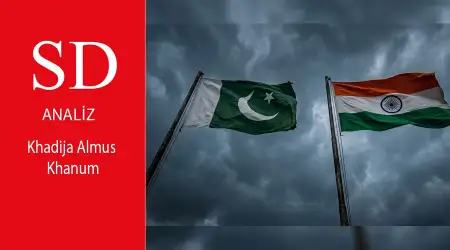
The diplomatic standoff between two South Asian nations, which began with the ouster of five-time former Bangladeshi Prime Minister Hasina Wajid and her escape to India on August 5, 2024 amid violent student protests, continues, with new issues escalating the situation and no immediate rapprochement in sight.
Last month, discussions between the two countries began over bilateral visits of premiers after Indian Prime Minister Narendra Modi extended an invitation to his Bangladeshi counterpart Tarique Rahman, whose party, the Bangladesh Nationalist Party (BNP), won a landslide victory in this year's February 12 general elections, to attend the two-day 18th BRICS Summit in New Delhi as a special guest on September 12. Since Bangladesh is not a member of the 11-nation BRICS, a bloc of emerging economies, India's invitation appeared to be an attempt to thaw the ice in over two years of strained relations with Bangladesh, which has a 4,096-kilometer (2,545-mile) land border surrounding the nation of 178 million people on three sides, with strong cultural and economic ties. This was India's second invitation to Rahman, who had previously been invited shortly after taking office as Bangladesh's prime minister in February 2026 and again in July for the BRICS Summit.
Nevertheless, Dhaka after the fresh invitation has placed stringent conditions on Rahman's visit to New Delhi, demanding that India must hand over Hasina, who was sentenced to death in absentia by the country's International Crimes Tribunal (ICT 1) on November 17 of last year for crimes against humanity related to a brutal crackdown on student-led protests in July-August 2024, in which thousands of people were killed and injured and her government eventually collapsed. Dhaka also called for the extradition of other Bangladeshi fugitives in India involved in the killings, including prominent student leader Sharif Osman Hadi, on December 12, 2025, in order to establish a favorable atmosphere for Rahman's visit.
As of September 3, the Bangladeshi prime minister had not yet formally consented to the visit to India, with several Indian media outlets reporting that Dhaka has imposed tough conditions on New Delhi in response to growing pressure from the largest Islamist party, Jamaat-e-Islami Bangladesh, and the Nationalist Citizens Party (NCP), a center-right political party formed in February 2025 in the aftermath of the student uprising that forced Hasina to flee to India.
- Hasina’s 20 years rule: India as Bangladesh’s closest ally
India has been Hasina's key ally since her first election in 1996, and she has consistently praised New Delhi's support for Bangladesh during its independence war in 1971. India, which also assisted her father, Mujib Rahman, in the creation of the country from Pakistan during a war. During Hasina's two decades in power, she remained a strong ally of India, ruling over Bangladesh as prime minister from 1996 to 2001 and from 2009 to 2024 through constitutional amendments and allegedly rigging elections, including the last one of her tenures on January 7, 2024, with a formal complaint filed by an individual accusing Hasina and her government officials of organizing the dummy election "under the directive of enemy state India."
Hasina's departure brought about a significant shift in the Bangladeshi government's foreign policy toward India. The former premier's extradition remains a major hurdle to normal relations between the two countries. Hasina, who ruled with an iron fist and imprisoned Rahman's mother, Khaleda Zia, a three-time prime minister, and other Bangladesh Nationalist Party leaders, is accused of using the country's Rapid Action Battalion (RAB), an elite security force she established with parliament's approval in 2003. This force was accused of abusing its authority against Hasina's political opponents, with hundreds "missing" throughout her tenure. A recent Bangladesh Commission of Inquiry uncovered significant enforced disappearances between 2009 and 2024, while the UN has not released an official figure of those missing. However, the UN Working Group on Enforced or Involuntary Disappearances identified 507 occurrences between 2009 and 2018, leaving 159 persons unaccounted for. For these reasons, the US imposed sanctions on the Rapid Action Battalion and six of its officials in 2021 on charges of serious human rights violations.
Earlier in 2013, the Jamaat-e-Islami was banned through the High Court, which cited constitutional violations and historical opposition to the country's independence in 1971. The Jamaat-e-Islami emerged in 1979 as the East Pakistani wing of the Jamaat-e-Islami Pakistan. Several of its leaders were captured, two were killed in prison, and five were executed following court verdicts for suspected war crimes committed during the Bangladesh War of Independence. Some Indian media accused Jamaat-e-Islami, which is currently playing an active role as a main opposition party with 68 seats in parliament since the interim setup led by Nobel laureate Dr. Muhammad Yunus lifted the ban on August 28, 2024, of pushing for Hasina's extradition to the country under the extradition treaty signed by both countries in 2013 as a condition for Rahman's visit to India and a step toward a conducive environment for improved relations between the two
At a time when Hasina's extradition was being demanded, on August 5, 2026, she held a press conference in India, her first public appearance since being ousted from power, vowing to return to the country in December this year, prompting the Bangladeshi Foreign Ministry to express outrage over the event commemorating the second anniversary of the students' uprising, calling it an affront to the sovereignty of Bangladesh and a grievous insult to the martyrs of the movement. According to The Indian Express, "many in Dhaka" view the Bangladesh government's demand to extradite Hasina and others as a "red line" or "final boundary." And many in New Delhi believe it is critical to inform the Bangladesh government about the future steps in the extradition request and to provide a "clear and reasonable response." Nonetheless, the handover of Hasina and others demanded by Bangladesh appears daunting as it would represent a loss of power in the region for New Delhi in the eyes of small neighboring countries like Bangladesh.
- India irked over Bangladesh's bid to join Mecca Defence Alliance
The latest in a string of thorny issues is statements by Bangladeshi government ministers indicating a desire to join the three-nation Mecca Defence Alliance of Türkiye, Pakistan, and Saudi Arabia if formally invited, with negotiations already begun. The August 7 pact intends to bolster collective defense and deterrence, with any armed attack on one of the three countries considered an attack on all three.
Bangladeshi Foreign Minister Khalilur Rahman told parliament last week that the country would seriously contemplate joining the alliance, describing it as an internal matter within the "Muslim family." While State Minister for Foreign Affairs Humaiun Kobir said on Sunday after meeting with Saudi Ambassador Abdullah Zafer bin Abiyah in Dhaka that Bangladesh is already discussing the matter with its international partners, expressing optimism that the agreement could open up "new opportunities" for the nation. Bangladesh must have a flexible foreign policy that takes into consideration the changing world circumstances. Kobir also said the agreement was reviewed during his recent travel to Jeddah, when he met with several officials, including Saudi Foreign Minister Prince Faisal bin Farhan Al Saud, and described the response from his counterparts as positive.
Although Indian media warned Bangladesh about joining the alliance, claiming it would be "dangerous" for the country, New Delhi's official position is that it is "closely monitoring" developments that could impact Indian security. Nevertheless, the Indian government has so far avoided issuing a categorical direct warning to Dhaka for several reasons, including trade and bilateral relations with Saudi Arabia. Yet, through Indian media, it is sending an indirect warning to Dhaka to avoid joining the military alliance, which appears to offer Bangladesh greater strategic depth and bolster its national security.
The argument in favor of Bangladesh joining the alliance is straightforward: if India can join and sign several military agreements, including with the US, Israel, and Russia, among others, how can it block or threaten small neighbors from joining the alliance for its own security benefits?
Shafiq Ahmad is a Pakistani journalist with extensive experience working with local and international print media and broadcast outlets, covering Pakistan, Afghanistan, and South Asian affairs.